

ASTM E779: Determining Air Leakage Rate by Fan Pressurization
Overview
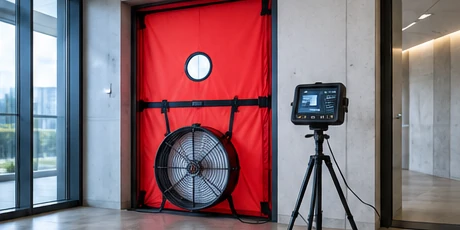
ASTM E779 establishes a standardized field-testing methodology for determining the air leakage characteristics of a building or building envelope component through fan pressurization. The procedure is intended to provide a consistent means of characterizing building airtightness by measuring the airflow required to establish and maintain controlled pressure differentials across the building enclosure.
Air leakage constitutes an important aspect of building enclosure performance. Uncontrolled airflow through cracks, joints, penetrations, openings, and discontinuities in enclosure assemblies can influence energy consumption, indoor environmental conditions, and the overall performance of a building. ASTM E779 provides a practical framework for quantifying this leakage under controlled test conditions.
Purpose and Significance

The principal objective of ASTM E779 is to provide a repeatable procedure for assessing the air leakage characteristics of a building or building envelope component. The method can be applied to characterize enclosure airtightness, compare the relative performance of buildings or enclosure conditions, investigate excessive leakage, and evaluate the effectiveness of air-sealing or remedial measures.
Because air leakage pathways are frequently distributed throughout an enclosure and may not be readily identifiable through visual inspection alone, whole-building fan testing provides a means of assessing their combined effect. The resulting measurements establish a quantitative representation of the leakage behavior of the tested enclosure rather than relying solely on the identification of individual leakage locations.
It is important to distinguish this procedure from measurements of natural infiltration or ventilation under normal operating conditions. ASTM E779 deliberately imposes pressure differentials across the enclosure so that the relationship between pressure and airflow can be evaluated under controlled circumstances.
Principle of the Test
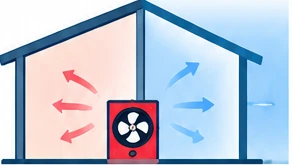
The test is based on establishing controlled pressure differentials between the interior and exterior of the building and measuring the corresponding airflow rates. A calibrated blower-door or comparable fan assembly is installed within an opening in the building enclosure and operated to either pressurize or depressurize the test zone.
Under pressurization, the fan introduces air into the building, increasing the interior pressure relative to the exterior. Under depressurization, air is exhausted from the building, producing a lower interior pressure. At a series of pressure conditions, the airflow necessary to sustain the imposed pressure differential is measured.
The resulting pressure-flow data are subsequently analyzed to characterize the leakage behavior of the enclosure. The standard provides a basis for determining parameters such as the air leakage coefficient, pressure exponent, and effective leakage area, which collectively describe the airtightness characteristics of the tested enclosure.
Test Preparation and Procedure
Prior to testing, the building or designated test zone is configured to establish a sufficiently uniform pressure condition. Interconnecting openings within the conditioned space are addressed in accordance with the procedure, while the operational condition of doors, windows, ventilation openings, chimneys, dampers, and HVAC penetrations is documented.
Environmental conditions are also evaluated before and during the test. Indoor and outdoor air temperatures are recorded because temperature differences can produce pressure variations associated with stack effect and may influence the interpretation of the measurements. Wind conditions are likewise considered, with relatively low wind speeds being preferable for reliable testing.
The fan assembly is installed in a suitable opening in the building enclosure and sealed around its perimeter to minimize leakage associated with the test installation itself. Differential pressure instrumentation is connected across the enclosure, and pressure measurements are taken at appropriate locations to verify that the test zone maintains an adequately uniform pressure distribution.
The fan is then operated through a sequence of pressure differentials. At each stabilized condition, the pressure difference across the enclosure and the corresponding airflow rate are recorded. Testing is conducted under both pressurization and depressurization conditions, providing a more comprehensive characterization of the enclosure's air leakage behavior.
Data Evaluation and Reporting

Following data acquisition, the measured airflow and pressure differential values are evaluated to establish the pressure-flow relationship of the tested enclosure. The resulting leakage parameters can subsequently be used to characterize overall airtightness and, where applicable, determine an effective leakage area at a specified reference pressure.
A comprehensive test report should document the building characteristics and test zone, the condition of relevant openings and mechanical systems, the equipment used and its calibration status, environmental conditions, pressure and airflow measurements, and any deviations from the prescribed procedure. The standard also provides for the estimation and reporting of confidence limits associated with derived results, recognizing that measurement uncertainty is influenced by instrumentation, test apparatus, and ambient conditions.
Practical Role in Building Enclosure Assessment

From a building enclosure perspective, ASTM E779 provides quantitative performance data that can be used to assess the overall airtightness of a building and to establish a measurable basis for interpreting enclosure performance.
The test results can help building professionals understand the magnitude of air leakage at the building level and place individual observations or suspected leakage pathways within the context of overall enclosure performance. When appropriately planned and interpreted, ASTM E779 can therefore form part of a broader building enclosure performance assessment program.
Short-Term and Long-Term Benefits
During construction and commissioning, ASTM E779 testing can provide the project team with measurable information about the completed enclosure.
Testing can help identify whether additional investigation or air-sealing work may be needed before project completion. When performed while relevant assemblies remain accessible, identified conditions may also be easier to investigate and address.
This can support:
• Building enclosure commissioning
• Construction quality assurance
• Evaluation of air-barrier installation
• Investigation of unexpected leakage
• Evaluation of corrective air-sealing work The value of air leakage testing can continue beyond construction.
A well-controlled air barrier can help reduce uncontrolled airflow through the building enclosure, which can contribute to more predictable HVAC operation, reduced energy demand, improved occupant comfort, and better control of moisture transport through enclosure assemblies.
ASTM E779 testing also establishes a quantitative record of enclosure airtightness at the time of testing.
That information can become a useful reference for future renovations, enclosure investigations, energy studies, or repeat testing as the building ages.
Conclusion
ASTM E779 provides a standardized approach for quantifying air leakage through a building enclosure by imposing controlled pressure differentials and measuring the associated airflow. Through systematic preparation, instrumentation, pressure testing, and data evaluation, the method enables engineers and building professionals to characterize enclosure airtightness and assess the effectiveness of air-leakage control measures.